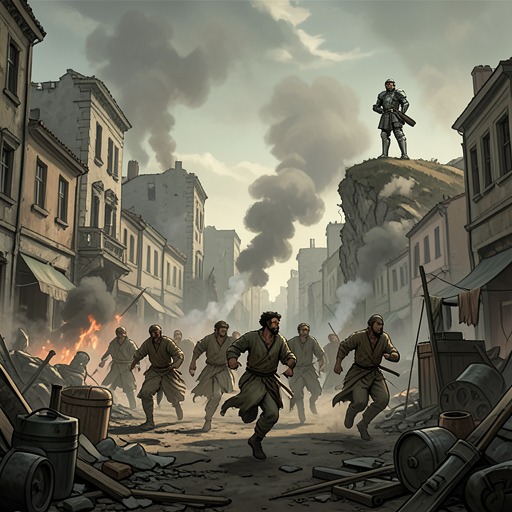
Dong Zhuo’s relocation of the capital and burning of Luoyang
The Romance of the Three KingdomsDong Zhuo’s relocation of the capital and burning of Luoyang marks the transformation of political domination into destruction on a vast scale. Framed as a plan to revive the Han court by moving it west to Chang’an, the decision instead brings executions, the seizure of property, the forced departure of the city’s population, and the destruction of Luoyang’s palaces, shrines, and tombs. The ruin encountered by the advancing forces makes the cost of the move concrete: the capital is not simply abandoned but emptied and devastated.
The case for moving the capital
Li Ru supplies the argument behind the relocation. He interprets the history of the Han capitals as a completed cycle: the dynasty began in the west, moved its seat east to Luoyang, and should now return to Chang’an. Dong Zhuo adopts this reasoning and summons the officials to announce the transfer, claiming that two centuries in Luoyang have drained the imperial family of its energy and that a move will renew it.
The language of restoration gives a political decision the appearance of a dynastic remedy. But the claim that the court will be revived in Chang’an does not translate into consultation or consent. Two officers attempt to stop Dong Zhuo as he leaves the city gate; he has them executed there. The resistance is brief, and its suppression establishes the terms on which the move proceeds: Dong Zhuo presents himself as acting for the dynasty while exercising power through force.
Plunder and forced departure
The move also creates a practical problem for Li Ru: Chang’an has been left nearly deserted since a rebellion two centuries earlier, and rebuilding it will require money. His proposed solution is to label Luoyang residents as associates of Yuan Shao, kill them, and take their possessions. The narrative presents the plan as a direct cause of the violence that follows, rather than as an incidental excess of the relocation.
Five thousand troops are sent into Luoyang. Thousands are killed, including leading nobles and wealthy merchants and their families, while the wider population is driven onto the long road to Chang’an. Many die during the journey; the soldiers also loot and abuse those caught up in the forced march. In this sequence, the supposed transfer of imperial life westward is inseparable from the dispossession of the people who had lived around the old capital.
Destruction of the old capital
Before departing, Dong Zhuo orders Luoyang itself destroyed. The order encompasses the city’s ancestral shrines and palaces, while the imperial tombs are broken open and their treasures scattered. Soldiers also enter the tombs of the nobility and the wealthy. The devastation therefore reaches beyond residences or administrative buildings: it attacks the places and objects through which dynastic memory and elite status are preserved.
The episode’s cumulative movement—from the announced transfer, through killings and expulsion, to the destruction of the city—makes the abandonment of Luoyang an act of deliberate devastation. The imperial institutions that the relocation is ostensibly meant to restore are carried away from a capital whose ceremonial and historical landmarks are left in ruins. The contrast exposes the distance between the rhetoric of renewal and the actions taken in its name.
The deserted city and its political meaning
After breaking through the pass, Xuande, his brothers-in-arms, and their men approach Luoyang, while Sun Jian rides toward it. What they find is devastation extending across hundreds of miles: the account describes no visible bird, animal, or human being. The scene offers the consequences of Dong Zhuo’s policy from the perspective of those arriving after the destruction, turning an earlier report of violence into an emptied landscape.
The destruction also belongs to the novel’s wider depiction of the Han’s disintegration. Its historical framework includes the breakdown of central government, the burning of the capital, and repeated battles; the dramatic retelling makes those changes legible through acts of betrayal, coercion, and loss. Luoyang’s ruin stands as a concentrated image of that collapse: the court can be moved, but the act of moving it does not restore the authority it claims to serve.